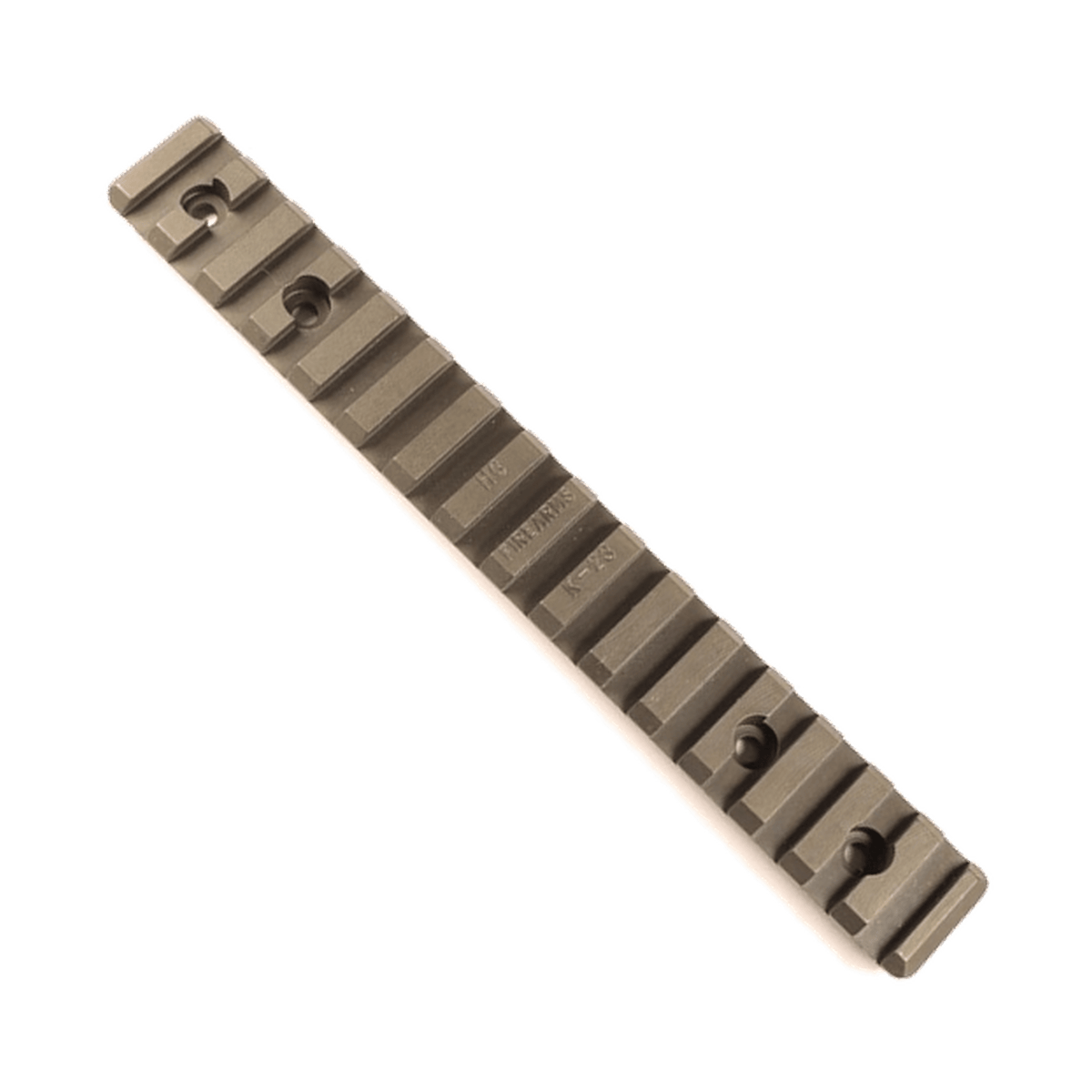
Picatinny rail for Barnard
Barnard was founded in New Zealand in 1982 and exclusively manufactures actions for long-range shooting and precision competitions such as F-Class. It's not a brand you encounter among the average hunter - Barnard actions are typically ordered by shooters who build rifles themselves with specific requirements for tolerances, receiver geometry, and trigger quality.
This makes the rail selection different from many other pages here. You're not choosing a rail for a mass-produced rifle with well-documented standard dimensions - you're choosing for an action that may appear in machined, customized, or newer versions with varying hole patterns. The Barnard SM Standard is the model covered here, but always check the actual dimensions of your specific action.
Barnard SM Standard and fit
The Barnard SM Standard uses specific hole spacing and bedding geometries that don't necessarily match other actions, even if the rifle outwardly resembles a standard bolt action. The Barnard Model S, for example, is described as having a footprint similar to certain Short Action standards - but with deviations that mean a rail dimensioned for another system will not fit correctly without verification.
The starting point is the A/B/C control dimensions. These show the hole spacing and bedding width on the action and are the only reliable basis for rail selection, regardless of what the model designation says.
MOA cant for long range
For precision shooting at long distances, it's relevant to consider whether the rail should have an MOA cant. A canted rail angles the scope's optical axis slightly downwards, giving you more upward adjustment range to work with - useful when many clicks are needed for elevation to reach the target. For F-Class and long-range use at 600-1000 meters, this is a real factor. For shorter distances, a flat rail is the simplest choice. The principle is explained in more detail in the guide on MOA cant.
Material for precision setups
A Barnard action is typically used in setups where precision and repeatability are prioritized. A steel rail is the natural choice here: it is dimensionally stable under varying temperature and humidity conditions and does not deform over time. Aluminum can be used in lighter setups, but for a Barnard-based build where the rest of the setup is chosen with consistency in mind, steel makes the most sense.
The material difference is covered in the guide on steel vs. aluminum for Picatinny.
Mounting
Mounting a Picatinny rail on a Barnard follows the standard procedure for two-way screws: ensure the contact surface is clean and oil-free, use thread locker on the screws, and tighten according to the manufacturer's instructions. The procedure is described step by step in the mounting guide.